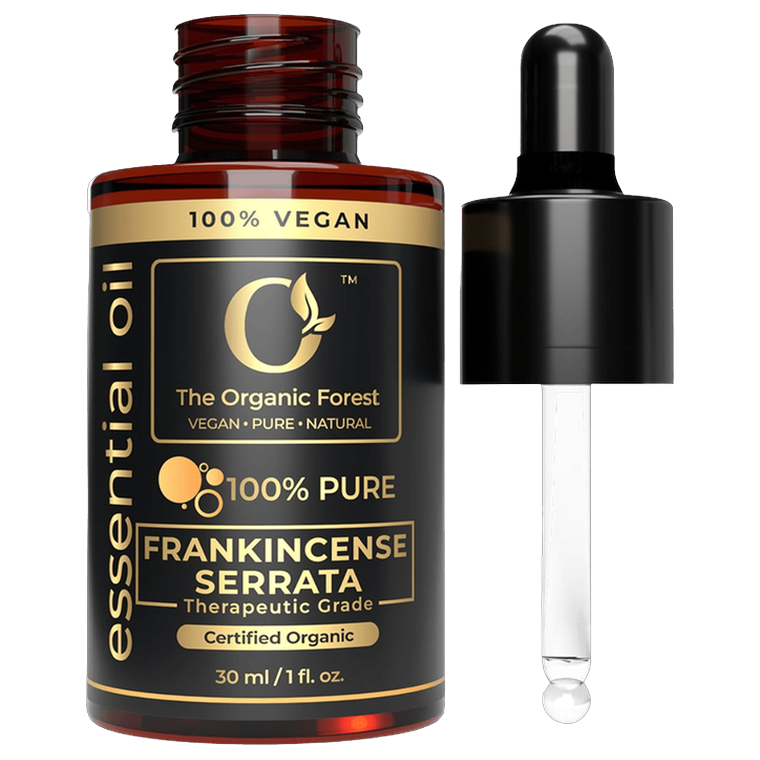
Moderate evidence Single-origin, GC/MS tested, CoA in every box.
Frankincense Oil carries an overall Moderate grade across the 13 studies linked on this page; the strongest signal is for anxiety/stress.
Animal research shows frankincense essential oil reduces corticosterone (stress hormone) levels and improves sleep in stress-induced rats, while a human quasi-experimental study found aroma hand massage (often including frankincense blends) reduced state anxiety in terminal cancer patients; however, direct high-quality human RCTs isolating frankincense alone for anxiety/stress are lacking.
“The Effects of Frankincense Essential Oil on Stress in Rats”
Read the study on PubMed →A BMJ systematic review (Ernst 2008) of 7 RCTs found Boswellia serrata (frankincense) extracts clinically effective across inflammatory conditions including rheumatoid arthritis and osteoarthritis, and multiple placebo-controlled RCTs in knee osteoarthritis (e.g., Kimmatkar 2003; Sengupta 2008, 5-Loxin) reported significant improvements in pain and physical function. Mechanistic and recent narrative reviews support anti-inflammatory action via 5-LOX, COX-2, and NF-kB inhibition, though the systematic review cautioned the evidence is 'encouraging but not compelling' due to small sample sizes and variable methodological quality.
“Frankincense: systematic review”
Read the study on PubMed →One RCT found that ultrasonic penetration with volatile Frankincense (Olibanum) oil combined with Chuanxiong Rhizoma oil improved pain scores (in male subgroup) compared to conventional ultrasound therapy for knee synovitis from sports injury, but effects on joint function and swelling were not superior to control.
“Effect of Ultrasonic Penetration with Volatile Oil of Olibanum and Chuanxiong Rhizoma on Acute Knee Synovitis Induced by Sports Training: An Open-Label Randomized Controlled Study”
Read the study on PubMed →A 2024 scoping review of essential oils for inflammatory skin conditions identified a placebo-controlled study showing positive effects of frankincense (Boswellia spp.) oil in treating psoriasis, though only one such trial is referenced and not independently detailed in these search results.
“The Therapeutic Potential of Essential Oils in Managing Inflammatory Skin Conditions: A Scoping Review”
Read the study on PubMed →Frankincense (Boswellia) appears only as a minor component in a multi-ingredient oral supplement trial for acne and is mentioned briefly in a scoping review of essential oils for inflammatory skin conditions, where it was noted for psoriasis/eczema rather than acne specifically; no dedicated clinical trial isolates frankincense oil's effect on acne.
“Novel combination for the treatment of acne differentiated based on gender: a new step towards personalized treatment”
Read the study on PubMed →Only one identified study (an animal model using Boswellia serrata/frankincense extract in an oleogel formulation) showed reduced wound size and inflammation in a rat scald burn model; no human clinical trials on frankincense for burns/wound healing were found among the retrieved PMIDs.
“Wound Healing Properties of Plant-Based Hydrogel and Oleogel Formulations in a Rat Scald Burn Model”
Read the study on PubMed →In vitro studies show Boswellia serrata (frankincense) essential oil/extract has antimicrobial activity against scalp-relevant organisms such as Malassezia spp., but no clinical trials in people with dandruff were identified.
“Synergistic antimicrobial activity of Boswellia serrata Roxb. ex Colebr. (Burseraceae) essential oil with various azoles against pathogens associated with skin, scalp and nail infections”
Read the study on PubMed →One animal (rat) burn wound study found Boswellia serrata extract in an oleogel formulation improved skin hydration and reduced inflammation, while another in vitro/formulation study used Boswellia serrata extract for nail hydration delivery rather than dry skin specifically; neither directly tested Frankincense essential oil on human dry skin.
“Wound Healing Properties of Plant-Based Hydrogel and Oleogel Formulations in a Rat Scald Burn Model”
Read the study on PubMed →A small double-blind trial found a topical formulation containing Boswellia serrata extract (Bosexil) improved itch and erythema in erythematous eczema patients compared to placebo, but this used a boswellic acid extract rather than frankincense essential oil itself; a second study only tested antimicrobial activity of a Boswellia dry extract in vitro with no direct eczema application.
“A cosmeceutical formulation based on boswellic acids for the treatment of erythematous eczema and psoriasis”
Read the study on PubMed →Evidence is limited to in-vitro work: Boswellia serrata (frankincense) essential oil showed antimicrobial activity against vaginal isolates including Candida albicans only at relatively high concentrations (25-50 µL/mL), and a referenced 2016 study suggests synergistic activity with azole antifungals against skin/scalp/nail pathogens. No human clinical trials, controlled studies, or systematic reviews were identified.
“Antimicrobial and Toxic Effects of Boswellia serrata Roxb. and Mentha piperita Linn. Essential Oils on Vaginal Inhabitants”
Read the study on PubMed →One observational study found an oral supplement combining Boswellia serrata (frankincense) with curcumin and grape seed extract improved telogen effluvium, but this does not isolate frankincense's individual effect or use topical/essential oil application; a second study is an in-vitro formulation/antioxidant characterization of frankincense resin with no hair-related outcomes tested.
“Treatment of telogen effluvium using a dietary supplement containing Boswellia serrata, Curcuma longa, and Vitis vinifera: Results of an observational study”
Read the study on PubMed →A single in-vitro/chemical profiling study found that Boswellia serrata (frankincense) essential oil showed tyrosinase inhibitory activity, suggesting potential relevance to hyperpigmentation, but no clinical or human trials support this use.
“Comparative metabolic profiling, enzyme inhibitory activities, and in-silico analysis of the hexane extract and the hydrodistilled oil of Boswellia serrata”
Read the study on PubMed →Only one animal study was found showing topical frankincense essential oil reduced corticosterone (stress hormone) and altered sleep architecture in sleep-deprived rats; the second PMID retrieved was an unrelated Cochrane review on collagenous colitis and not relevant to sleep.
“The Effects of Frankincense Essential Oil on Stress in Rats”
Read the study on PubMed →No PubMed-indexed studies were found evaluating Frankincense oil for under-eye dark circles; any use for this purpose is based on anecdotal or traditional skincare claims rather than clinical research.
Study counts reflect our internal research database. Figures are honest tallies, not marketing claims; every linked study opens on PubMed.