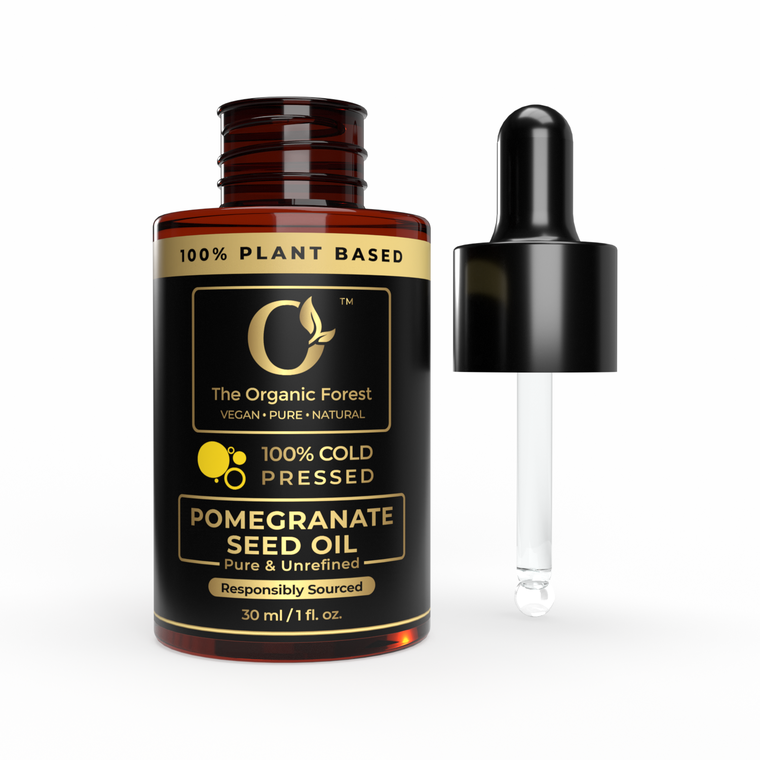
Hi — I handle bulk & wholesale for this oil. Ask me anything, or tap a question below.
What the research says
More than a carrier. And we cite every word.
People reach for Pomegranate Seed for more than one thing. Here’s what the published studies actually found — graded honestly, each one linked.
13
uses studied
30
papers cited
0
hidden from you
What the published studies found
Moderate evidence · 4 studies
Hyperpigmentation
A 2025 randomized, double-blind, placebo-controlled trial (60 women) of aged Punica granatum extract showed significant reductions in UV-induced melanin levels and improved skin lightness versus placebo, while a 2005 in-vitro study showed pomegranate fruit extract inhibits UV-B-induced MAPK and NF-kB signaling in human keratinocytes, a pathway relevant to pigmentation. However, both studies used polyphenol-rich pomegranate fruit/aged extracts, not pomegranate seed oil specifically, so the evidence is indirect for the seed oil.
The available evidence is preclinical: gelatin dressings containing Punica granatum extract significantly improved wound contraction and histological healing (granulation, collagen deposition) in animal models, and a referenced peel-extract ointment showed similar in vivo healing effects. Critically, these studies used polyphenol-rich peel/fruit extracts (gallic acid, ellagic acid), not pomegranate SEED oil, and no human RCTs or systematic reviews were identified.
Only one human study is even indirectly relevant: a small 6-week trial (n=18) of a multi-herbal cream containing Punica granatum seed extract alongside ~10 other botanicals and emollient oils, which improved skin hydration by ~16-18% versus control. Because pomegranate was a minor component of a complex formulation, its specific contribution to skin hydration cannot be isolated, and no study has tested pomegranate seed oil alone for dry skin.
The retrieved evidence consists of a narrative review listing Punica granatum among several herbal candidates for rheumatoid arthritis (PMID 32586262) and a preclinical study (in silico, in vitro, and rat models) on rosmarinic acid isolated from pomegranate showing immunomodulatory/anti-inflammatory activity (PMID 38445701). No human clinical trials—let alone RCTs—of pomegranate seed oil for joint inflammation were identified, and the available studies address pomegranate plant extracts generally, not seed oil specifically.
The only directly relevant evidence is a preclinical mouse study (PMID 35153762) showing pomegranate (Punica granatum) PEEL polysaccharides—not seed oil—ameliorated imiquimod-induced psoriasis-like dermatitis by suppressing NF-κB/STAT3 signaling and reducing TNF-α, IL-6, IL-17, and IL-23 while improving skin barrier markers (AQP3, FLG). No human clinical trials exist for pomegranate seed oil in psoriasis; the systematic review found (PMID 26887532) mentions pomegranate only for cardiovascular disease and psoriasis only in relation to aloe vera.
The only condition-relevant study found is an in-vitro experiment showing that ellagitannins isolated from pomegranate flower (not seed oil) downregulated MMP-1 expression and increased type I collagen in UVA-irradiated skin cells, suggesting anti-photoaging potential. No human clinical trials, RCTs, or studies specifically testing pomegranate seed oil for aging or wrinkles were identified in the provided results (the other retrieved study, PMID 32174405, concerns dental bonding and is irrelevant to skin aging).
No clinical studies have tested pomegranate seed oil for dandruff. The only tangentially related evidence is an in-silico molecular docking study screening Punica granatum phytochemicals (not the seed oil itself) against Staphylococcus epidermidis, a bacterium the authors mention as dandruff-associated, while a second paper on pomegranate seed oil neuroprotection merely notes in passing that seed oils are traditionally used topically for dandruff.
In vitro and in silico evidence shows that a Punica granatum ethyl acetate fraction and its compound galloyl-HHDP-glucose inhibit Candida spp. (MIC 31.25–250 μg/mL), disrupt biofilms, reduce phospholipase production, and act synergistically with fluconazole. However, no human clinical trials exist, and the studied preparation was a solvent extract (plant part unspecified) rather than specifically pomegranate seed oil.
No clinical trials evaluate pomegranate (let alone pomegranate seed oil specifically) for headache or migraine. One narrative review documents traditional Persian medicine use of Punica granatum among gastroprotective herbs for headache management via the gut-brain axis, but this reflects historical practice and mechanistic speculation rather than tested clinical efficacy.
No human clinical trials were found testing pomegranate seed oil for rash or contact dermatitis. The most relevant evidence is preclinical: a 2025 study (PMID 41248721) showed a pomegranate seed oil nanocapsule hydrogel reduced UVB-induced skin inflammation, oxidative stress, and tissue damage in mice, while a review (PMID 34923641) mentioned anti-inflammatory effects in contact dermatitis only for pomegranate peel — a different plant part than seed oil.
No human clinical trials have evaluated pomegranate seed for insomnia. The only direct preclinical study found that Punica granatum seed extract actually increased sleep latency and reduced sleeping time in mice—the opposite of a sedative effect—while a systematic review of intranasal herbal medicines listed insomnia among studied conditions but mentioned pomegranate only in the context of mild adverse effects.
The only identifiable relevant study is a 2025 systematic review on phytotherapeutic analgesics for dental pain (PMID 41322706), which lists punica granatum (pomegranate) among several plant agents with analgesic properties. No studies directly examine pomegranate seed oil for muscle pain, so the evidence is indirect and tangential at best.
A 2024 narrative review of Punica granatum (pomegranate) dermatological effects mentions positive effects on striae distensae (stretch marks) among investigated benefits, but explicitly states that evidence comes mostly from in vitro and animal studies, with only a few effects confirmed in human subjects. No RCTs or systematic reviews specifically evaluating pomegranate seed oil for stretch marks were identified in these results.